
How to Breathe Correctly: in Meditation and Beyond

What does correct breathing mean?

Do you think it is a bit of a joke that breathing needs a separate how-to? Our automatic actions, like walking or breathing, by definition, don’t get much attention from our part. But automaticity does not guarantee that an action is carried out in an appropriate (and healthy) way. When something is unconscious, we are unable to assess its appropriateness, and, subsequently, we cannot change the way we act.

How to breathe correctly while meditating

Meditation takes an unconscious act (breathing) and takes it to the surface of consciousness. By focusing on our breath, we also gain control over our thoughts and feelings. Correct breathing exercises are “active ingredients” of meditation. This is why it’s extremely important to learn the difference between unhealthy and healthy ways of breathing. Not only will you be able to meditate properly, but you’ll also learn how to recognize when your “breathing technique” is bad. By regaining control over your breath, you’ll be able to attain the state of peace and tranquility even in the most stressful situations
But let’s first see what are the “trademarks” of bad breathing.

Examples of improper breathing

First of all, bad breathing is almost always shallow. Shallow breathing has numerous detrimental consequences. For instance, when your breath is shallow, chances are that your brain doesn’t get enough oxygen (and, inversely, your body gets too much CO2). Your body recognizes these changes as stress-related signals and initiates numerous compensatory activities that are meant to make up for these detrimental changes. Needless to say, if your body is forced to cope with shallow breathing for too long, at one point the stress will become overwhelming, and compensatory activities (increased activity of the thyroid and adrenal glands) will no longer help. Quite the contrary. Increased activity of adrenal glands is a typical somatic response in almost all stressful situations, and this kind of response usually helps you to overcome the challenge. However, when the stressful situation lasts for too long (or when we are unable to deal with it), the increased activity of adrenal glands puts too much strain on your body. This type of maladaptive reaction is observed in some stress-related psychopathological syndromes like Post-Traumatic Stress Disorder (PTSD). Just so you know, you can check our targeted meditation practice to help with PTSD here.

How improper breathing affects health

Shallow breath is linked with negative emotions like fear, feeling threatened, nervousness, and anxiety. The list goes on and on, but these are the most dangerous (and negative) emotions linked with shallow breathing.

Bad breathing correlates with bad posture, which is, of course, another topic. However, your breathing method is most surely unhealthy if you, for example, have the so-called “forward head”, which is essentially the way you hold your head while you’re using your mobile phone. You can try this for yourself, as a little experiment: Just bend your head forward as much as you can, and you’ll see that it’s extremely hard to breathe in this position.

What is it proper breathing technique

Deep diaphragmatic breathing isn’t only beneficial for the mind. Some studies have shown numerous physiological changes that can be ascribed to diaphragmatic breathing therapy. For instance, diaphragmatic causes a significant increase in O2, while decreasing the amounts of CO2 in the body. In other words, the psychological effect of proper diaphragmatic breathing cannot be analyzed separately from its physiological reactions.

how to breathe correctly while meditating

There are numerous ways to practice diaphragmatic breathing. First of all, you’d want to perform breathing exercises in several positions. The efficiency of supine, lateral decubitus, sitting, and standing positions has been empirically proven (Wellington et al. 2012). After you make yourself comfortable (in one of these positions) take, a slow, deep breath, while paying attention to the movement of your belly.
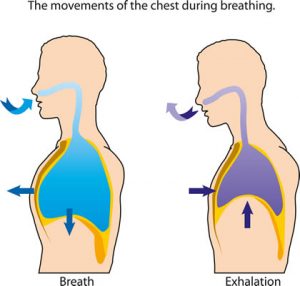
correct deep breathing techniques


Diaphragmatic breathing is characterized by slow, constant ascendance and descent of your abdomen, so make sure to pay attention to this important aspect. After inhaling deeply through your nose, slowly exhale, by pushing out all the air from your lungs. Don’t force anything. Diaphragmatic breathing is steady, slow, and relaxed. You can also put a hand on your belly so that you get tactile feedback.


Guide how to breathe correctly

It is now believed that various yogic breathing exercises achieve their effect thanks to diaphragmatic breathing. One such yogic technique is called pranayama, which is, essentially, a term that designates our ability to control the breath. Prana, life’s vital force, is increased thanks to pranayama exercises. However, these yogic breathing exercises have some special characteristics, like yogic poses.

One of the alternate correct way to breathe is nostril breathing, another yogic technique that has so many psychological and physiological benefits that we won’t even try to mention them all.

We will only give you a guide on proper inhale and exhale techniques through the nose:

1. First, you should place one of your hands on your knee (if you are left-handed, put your right hand on your right knee. The opposite goes for right-handed individuals)


2. Lift one of your hands (left for left-handed, right for right-handed), towards your nose.
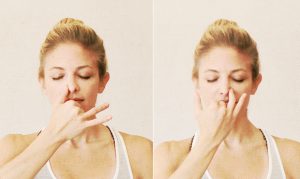
close one of your nostrils

3. After exhaling (make sure to empty your lungs) close one of your nostrils with your thumb (right nostril if you use your right hand… you get the idea).

4. Inhale deeply through the open nostril.

correct breathing

5. Then close this nostril and inhale deeply through the other nostril.

6. Repeat this circle for about 5 minutes (i. e. inhaling through one, then the other nostril).

In conclusion, the proper way to breathe diaphragmic will do wonders for your mental and physical health. Developing it is not rocket science, but a gradual process to move away from shallow patterns to deeper ones. With time, your meditation practice but also everyday life would benefit from better breathing.

Have a very good practice, everyone!

Mindfulness Meditation to Help with PTSD

PTSD, Meditation, and Psychotechnology

Post-Traumatic Stress Disorder (PTSD) is a mental health issue that some people develop after they have been exposed to a shocking event in their life. It can be it life-threatening situation, combat, incarceration, natural disaster, sexual assault or similar. 

The US. Department of Veteran Affairs stated that 8 out of 100 veterans clearly experience PTSD. They have stated that it is normal to have upsetting memories and feeling. However, if they last over a few months, it is time to get help. Majority of people diagnosed with PTSD are prescribed psychotherapy which is 53% effective and medication which is 46% effective on average. Meditation for PTSD is growing popularity too. 

We at Ahimsa Meditation refer to mindfulness meditation as psycho-technology. It is a practice to help people suffering from the first symptoms of PTSD to cope with it and potentially fully recover before it goes any further. Though it is also very effective as a complementary practice to help sufferers who are taking medication or attending psychotherapy sessions. 

Scientists agree that mindfulness meditation helps with PTSD

Meditation can help with common mental health issues like OCD, PTSD, panic attacks (from “The Effortless Mind” by Will Williams, founder of World Meditation Day).

Researchers from Maharishi International University taught meditation to prisoners with a standard prison program as a comparison. They found that 4 months later the prisoners doing meditation showed fewer symptoms of trauma, anxiety, depression; they also slept better and perceived their days as less stressful (from S. Nidich et al., “Reduced trauma symptoms and perceived stress in male prison inmates through Transcendental Meditation Program” in Permanente Journal 2016; doi.org/10.7812/TPP/116-007)

Prison Mindfulness Institute offers a 6 weeks mindfulness course dedicated to nurturing inner peace and more effective rehabilitation for prisoners and ex-convicts. Resettlement programs in the United Kingdom prisons also feature mindfulness as a pathway to effective rehabilitation after incarceration. Meditation for PTSD is a growing area of interest in the US, UK and worldwide.

It is not surprising that both ex-military, police force and prisoners are recipients of mindfulness meditation practice sessions specially designed to help or in some cases even prevent PTSD. See more information and scientific references on meditation practice benefits.

Mental health is important and mindfulness is an integral part of the treatment of various psychological disorders such as anxiety, depression, post-traumatic stress disorder (PTSD), borderline personality disorder and more (from “The rough guide to mindfulness” by Albert Tobler and Susann Herrmann).

Mental muscle training

Mindfulness training may indeed build up the “mental muscle” in these brain regions in people who are trying to change addictive behaviors. In this way, they are able to notice cravings and related self-referential thinking patterns, allowing them to ‘ride this wave’ of experience rather than being sucked into it. 

Randomized control trials demonstrated improvement through mindfulness training for a long list of conditions: coping with diabetes, cancer, chronic pain, work stress, chronic fatigue syndrome, stress eating, HIV quality of life, smoking cessation, hot flashes, insomnia, substance use disorder. (From “Mindfulness and Psychotherapy” 2nd Edition by C. Germer, R. Siegel, P. Fulton.)

For PTSD and everyone’s suffering from traumatic experiences in the past, we introduce an element of ‘clarification of values’ mediation to extend a participant’s circle of compassion and nonviolence. This is done by means of mindfulness meditation.

Mindfulness meditation invites your fear for tea

Trauma-related and PTSD themed mindfulness meditation simply wants to invite fear for tea. You just have a chat, look at it, observe and simply accept.

You can think about as ‘what we cannot hold, we cannot process, what we cannot process, we cannot transform. What we cannot transform, we cannot transform haunts us’.

With post-traumatic stress disorder, Ahimsa Meditation would like to focus on two characteristics that would be great to contemplate during your practice to help deal with your PTSD. These are:

  • impermanence, which allows anyone to stop being reluctant to accept that everything is changing all the time;
  • suffering or unsatisfaction that occurs as a result of clinging to our day-to-day desires.

How do you employ mindfulness meditation for PTSD?

Practising meditation for PTSD is really easy and you can try it right now with these simple instructions for a concentration meditation on breathing with elements of vipassana meditation directed at post-traumatic stress disorder:

  • Find a quiet place and set your alarm for an initial 10 minutes (more if you feel comfortable to start with a longer session).
  • Sit cross-legged on a floor (use a mat and a cushion to level your hips with your knees), place your arms on your lap. Only sit on a firm chair if the cross-legged position is very uncomfortable. In general, your posture should be fairly relaxed but not sluggish, so you won’t meditate yourself to sleep. Surely, the full lotus is the most stable and firm posture, yet you can adopt half-lotus or a simple cross-legged position too.
  • Take a few really deep breaths as so other people would be likely to hear you breathing. It should make you feel relaxed fairly quickly.
  • Close your eyes and start paying attention to sounds, smells, your posture, and breathing. Simply make a mental note on what you are observing. No need to judge it or dwell on it.
  • Pay attention to how your body feels. Start doing so by scanning your body from top to bottom and notice how even the smallest parts of your body feel. Don’t try to change anything or judge. It’s all good, you are being attentive, that’s it.
  • Move the focus of your attention to your breathing. Do not try to change it, just let it be. No judgment please, do not allow to be violent towards yourself. Notice where in your body your breathing starts, how it flows and how it ends. To help you settle with this pattern, you can start counting your breaths from 1 to 10 and then revert back to 1. If your attention shifts to something else, notice the very fact of this happening and then gently get your mind to count the breaths again and again. Yet these ‘jumps’ happen all the time, so be kind to yourself. The more skillful you become, the less monkey-like your mind learns to be. Every single time your mind gets back to counting breaths, it also gets stronger. This, in effect, gives your mind a proper training.
  • When you have established a good concentration on breathing, invite your mind to contemplate on the fact that all things change; it is just the way of life. Think about life and death, but also about these traumatic experiences that get you where you are now. These will change too.  This is impermanence in your life. Accept it and relieve yourself from the pressure of stress factors. They will come and go too.  
  • Obviously, these stress factors come with unsatisfaction and sometimes suffering. It happens because you cling to positive states, and quite naturally averse to things that cause you pain. You want to get rid of your traumatic experience and get back to happy memories. Yet the issue is that it doesn’t usually help. Yet it only creates more stress. If you look directly at your trauma and try and make friends with it, you can contemplate whether you can simply let go of your attachment to that trauma. This will definitely alleviate your stress. If you cannot just let go of it, simply say  ‘yes I accept my [your own traumatic experience goes here], and that’s why I feel stressed’. You acknowledge your suffering and, paradoxically, it will subside. You will feel it less and with time it will disappear. 
  • These two very specific but open contemplation themes are going to change on a daily basis. Things change, so is your meditation practice. Yet with time, you will become familiar with both of these characteristics and your level of stress will gradually lessen. You will accept these as the universal truth. Everyone experiences dissatisfaction and all things are impermanent. Your full acceptance and absence of clinging are key to lower your stress.  
  • Your inner values can give you an emotional boost. Contemplate about what they are for you. Why do you wake up in the morning? Is it something that you do, how you serve others, how you connect with other people? How do you help your kids or maybe your customers? Re-connect with your inner values, feel the power of them. Contemplate them during your meditation.
  • Continue for your set amount of time. When finished, allow your mind to rest for 30 seconds with no focus on anything at all. Just observe and let it simply flow.
  • Finish by making a mental note how you feel now, what you are going to do next and open your eyes.

You have just completed a session of mind training or cultivation that specifically targeting PTSD. 

If you allow awareness to embrace your doubt, your unhappiness, your confusion, your anxiety, your pain, these mental states cease to be ‘yours’. They revert to being recognized as merely ‘weather patterns’ in the mind and body (from “Falling Awake” by Kabat-Zinn).

meditation for PTSD

Be aware of your trauma and your stress will lessen

Surely, this awareness or self-observation will help you to come to terms to whatever was giving you that much stress. It is a gradual process. It is a journey, but it is so much worth doing. Try it today or forward this guide to people who may need it.

We aim to engage with ex-military, police force, ex-prisoners and victims of violence or sexual abuse to help them overcome this enormous trauma. Mindfulness meditation for PTSD works well in conjunction with therapy and rehabilitation programs.  Connect with us, support us and let’s cultivate inner peace together. 

Free Access to Meditation Guide & Courses

You have Successfully Subscribed!