
What does correct breathing mean?
Do you think it is a bit of a joke that breathing needs a separate how-to? Our automatic actions, like walking or breathing, by definition, don’t get much attention from our part. But automaticity does not guarantee that an action is carried out in an appropriate (and healthy) way. When something is unconscious, we are unable to assess its appropriateness, and, subsequently, we cannot change the way we act.
How to breathe correctly while meditating
Meditation takes an unconscious act (breathing) and takes it to the surface of consciousness. By focusing on our breath, we also gain control over our thoughts and feelings. Correct breathing exercises are “active ingredients” of meditation. This is why it’s extremely important to learn the difference between unhealthy and healthy ways of breathing. Not only will you be able to meditate properly, but you’ll also learn how to recognize when your “breathing technique” is bad. By regaining control over your breath, you’ll be able to attain the state of peace and tranquility even in the most stressful situations
But let’s first see what are the “trademarks” of bad breathing.
Examples of improper breathing
First of all, bad breathing is almost always shallow. Shallow breathing has numerous detrimental consequences. For instance, when your breath is shallow, chances are that your brain doesn’t get enough oxygen (and, inversely, your body gets too much CO2). Your body recognizes these changes as stress-related signals and initiates numerous compensatory activities that are meant to make up for these detrimental changes. Needless to say, if your body is forced to cope with shallow breathing for too long, at one point the stress will become overwhelming, and compensatory activities (increased activity of the thyroid and adrenal glands) will no longer help. Quite the contrary. Increased activity of adrenal glands is a typical somatic response in almost all stressful situations, and this kind of response usually helps you to overcome the challenge. However, when the stressful situation lasts for too long (or when we are unable to deal with it), the increased activity of adrenal glands puts too much strain on your body. This type of maladaptive reaction is observed in some stress-related psychopathological syndromes like Post-Traumatic Stress Disorder (PTSD). Just so you know, you can check our targeted meditation practice to help with PTSD here.
How improper breathing affects health
Shallow breath is linked with negative emotions like fear, feeling threatened, nervousness, and anxiety. The list goes on and on, but these are the most dangerous (and negative) emotions linked with shallow breathing.
Bad breathing correlates with bad posture, which is, of course, another topic. However, your breathing method is most surely unhealthy if you, for example, have the so-called “forward head”, which is essentially the way you hold your head while you’re using your mobile phone. You can try this for yourself, as a little experiment: Just bend your head forward as much as you can, and you’ll see that it’s extremely hard to breathe in this position.
What is it proper breathing technique
Deep diaphragmatic breathing isn’t only beneficial for the mind. Some studies have shown numerous physiological changes that can be ascribed to diaphragmatic breathing therapy. For instance, diaphragmatic causes a significant increase in O2, while decreasing the amounts of CO2 in the body. In other words, the psychological effect of proper diaphragmatic breathing cannot be analyzed separately from its physiological reactions.

There are numerous ways to practice diaphragmatic breathing. First of all, you’d want to perform breathing exercises in several positions. The efficiency of supine, lateral decubitus, sitting, and standing positions has been empirically proven (Wellington et al. 2012). After you make yourself comfortable (in one of these positions) take, a slow, deep breath, while paying attention to the movement of your belly.
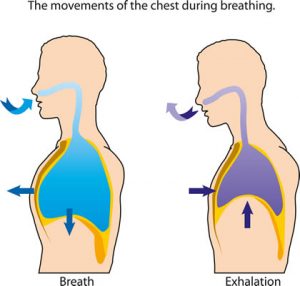
Diaphragmatic breathing is characterized by slow, constant ascendance and descent of your abdomen, so make sure to pay attention to this important aspect. After inhaling deeply through your nose, slowly exhale, by pushing out all the air from your lungs. Don’t force anything. Diaphragmatic breathing is steady, slow, and relaxed. You can also put a hand on your belly so that you get tactile feedback.
Guide how to breathe correctly
It is now believed that various yogic breathing exercises achieve their effect thanks to diaphragmatic breathing. One such yogic technique is called pranayama, which is, essentially, a term that designates our ability to control the breath. Prana, life’s vital force, is increased thanks to pranayama exercises. However, these yogic breathing exercises have some special characteristics, like yogic poses.
One of the alternate correct way to breathe is nostril breathing, another yogic technique that has so many psychological and physiological benefits that we won’t even try to mention them all.
We will only give you a guide on proper inhale and exhale techniques through the nose:
1. First, you should place one of your hands on your knee (if you are left-handed, put your right hand on your right knee. The opposite goes for right-handed individuals)

2. Lift one of your hands (left for left-handed, right for right-handed), towards your nose.
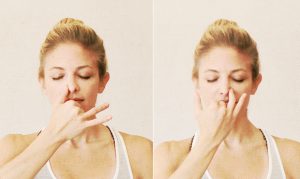
3. After exhaling (make sure to empty your lungs) close one of your nostrils with your thumb (right nostril if you use your right hand… you get the idea).
4. Inhale deeply through the open nostril.

5. Then close this nostril and inhale deeply through the other nostril.
6. Repeat this circle for about 5 minutes (i. e. inhaling through one, then the other nostril).
In conclusion, the proper way to breathe diaphragmic will do wonders for your mental and physical health. Developing it is not rocket science, but a gradual process to move away from shallow patterns to deeper ones. With time, your meditation practice but also everyday life would benefit from better breathing.
Have a very good practice, everyone!

