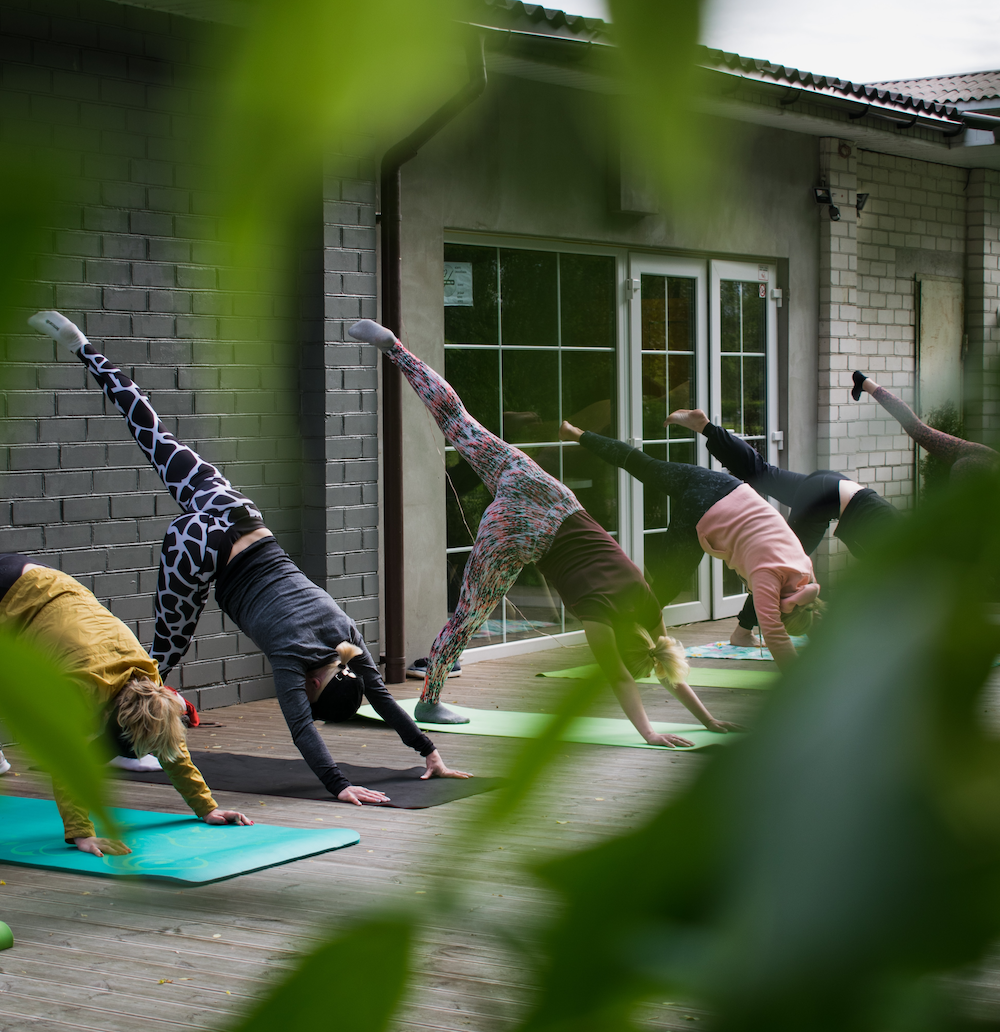
Somewhat obscure beginnings of yoga span more than 5 millennia. The East Indian culture is considered as yoga’s cradle, with Patanjali as its founding father (Forfylow, 2011). Yoga was just one part of his philosophical system, which incorporated 6 ways of attaining unity of the body and mind. The word itself, “yoga”, can be roughly translated as “joining the mind and body in harmonious relaxation” (Fortylow, 2011, p.134). This article introduces how yoga and meditation complement your health and well-being.
Pillars of Yoga
Hatha yoga (and its many varieties) is by far the most popular type of yoga in the world. Although there are some differences, all styles of yoga have a set of common characteristics:
- Breathwork – this aspect can be regarded as the backbone of all yoga styles. Each yoga exercise or posture starts with steady, concentrated breathing, after which various postures are practiced. The calming effect of breathing exercises has been noticed since yoga’s inception. Breathing exercises can have both energizing and calming effects. The so-called Ujjayi technique is believed to stimulate and energize, while Bhastrika breathing has a calming effect.
- Postures are yoga’s “trademark”. Almost all individuals, even the ones who have barely even heard of yoga, know that yoga involves some kind of peculiar postures. The Sanskrit word for postures, asana, also means “flexibility, balance, circulation, and coordination”. There are many asanas in yoga, and each has its purpose- exercising a certain part of the body. Utilization of training tools, such as weights, is fairly uncommon in yoga, especially in its traditional forms.
Mindful Asanas
Postures, while being good for the body, also benefit the mind. The benefits aren’t confined to soothing and calming sensations that are so often associated with Eastern traditions. Just as breathing exercises can be invigorating, many yoga postures stimulate one’s energy. The classification relates specific postures with their respective effects on the mind.
This list shouldn’t be taken for granted, as some individuals might have different experiences with yoga postures:
1. Forwards bends= attaining the state of serenity, and calmness
2. Backbends and inversions= energizing and invigorating
3. Balancing postures= transferring bodily strength and poise into the mind
Yoga and Neurology
It’s easy to say “this breathing exercise is for that”, or “do this posture and you’ll feel this or that”. Scientists with rather diverse backgrounds aren’t satisfied with such statements. So they wanted to empirically test yoga’s effectiveness. They found that yoga has a plethora of health benefits, including “the mitigation of gene expression changes in response to social adversity; reduction in perceived loneliness; decreased inflammation; improved immune regulation; mental flourishing; and decreased all-cause mortality independent of other variables” (Sullivan et al. 2018).
Neuroscientists use a term that encompasses all these health benefits- eudaimonic well-being.
In other words, yoga affects (positively) both the mind and body.
Recently neuroscientists began making various theoretical models, hoping to find out how yoga changes the way we feel (Deshmukh, 2006).
Sullivan and colleagues tried to link yoga with some modern neurological theories, like PVT (Polyvagal theory). These researchers combined a thorough understanding of yoga- of which the concepts of 3 gunas (rajas/tamas/sattva) are the most important ones- and three important neural platforms. But let’s first explain the gunas. Gunas are qualities of Prakriti- material world. Purusha is the spirit that perceives these qualities.
About Gunas
So the the three gunas are:
1. Sattva is the state of calmness, serenity, and pleasure. Although it may seem that we should focus on this quality, it isn’t necessarily so. Yoga is the balance of all three gunas. You shouldn’t overemphasize one at the expense of the others. If one indulges in joy and pleasure excessively, the balance is lost.
2. Rajas is a turbulent, invigorating, and energizing state. Activity is rajas’ most important characteristic. Emotions like anger are also linked with rajas. Pain is as well. Just as we mustn’t overemphasize sattva, so we shouldn’t try to completely mitigate the rajas. Balance is the key.
3. Tamas is situated between sattva and rajas. It is neither positive nor negative. It’s indifferent and linked with inertia. When balanced with other gunas, tamas will bring stability.
As neurology developed, we’ve begun to find special neurological systems with numerous purposes. Of those, three systems are often mentioned as the most important- sympathetic nervous system (SNS), dorsal vagal complex (DVC), and ventral vagal complex (VVC). These systems are crucial for the integration of information received from the body’s periphery. We may even regard them as systems of neurons for the perception of Prakriti- the material world. A balanced integration of information coming from all three systems is crucial for psychological and physiological equilibrium.
Neurologists concluded that gunas are in fact systems of neurons (neural platforms). Sattva (joy, pleasure, etc.) has its basis in the ventral vagal complex (VVC). VVC, in turn, is crucial for interoception and relaxation, allowing the seamless interpretation of facial cues and prosody.
Not surprisingly, rajas is linked with the sympathetic nervous system. This system has a “stimulant” effect on the organism. It is about the so-called “fight or flight” actions. Overactivation of this system results in stress, fear, anxiety, and hostility.
Finally, tamas has its basis in the dorsal vagal complex. It is known to transmit sensations like stability, indifference, and inertia.
Yoga and Meditation: Mindful Integration
Just as all three neural platforms (or gunas) have to work together to attain the equilibrium, so is the combination of yoga postures, breathing exercises, and meditation the best “remedy” for both the body and mind. Sullivan and colleagues don’t think that by saying “yoga postures are for body and meditation is for the mind”, we tend to oversimplify an extremely complex phenomenon.
Meditation is a state of deepest contemplation. Evidently, it comes from the Latin word “meditationem”, which also means “to think, consider, reflect” (Online Etymology Dictionary, n.d). As of recently, it acquired a slightly different meaning that doesn’t incorporate much cognitive work, whereas psychological serenity is emphasized. In the traditional sense, meditation is the highest level of the body/mind integrity. It is the contemplation of the most important principles of life.
You can start your day by a basic concentration meditation (perfect meditation for beginners) or develop your vipassana meditation practice. You can follow it up by a sun salutation yoga sequence and get yourself fully ready for a brilliant day ahead.
If you do a more robust yoga practice like attending a class, it usually finishes with a corpse pose. Surely, it allows you not only to rest well after yoga session but also to meditate a little bit in a very relaxed way.
As you can see, the options are there, not it is your turn – try to establish a meditation routine and follow it up with a simple yet so effective yoga sequence. Your mind and body would thank you for that.
Enjoy!
References cited above:
- Deshmukh, V.D. (2006). Neuroscience of Meditation. The Scientific World Journal. Vol. 6, pp. 2239-2253. Doi: 10.1100/tsw.2006.353
- Forfylow, A. L. (2011). Integrating Yoga with Psychotherapy: A Complementary Treatment for Anxiety and Depression. Canadian Journal of Counseling and Psychotherapy. Vol. 45(2), pp. 132-150. Available at: https://files.eric.ed.gov/fulltext/EJ930795.pdf
- Online Etymology Dictionary (n.d.). Available at: https://www.etymonline.com/word/meditation
- Sullivan, M.B., Erb, M., Schmalzl, L., Moonaz, S., Taylor, J.N. & Porges, S.W. (2018). Yoga Therapy and Polyvagal Theory: The Convergence of Traditional Wisdom and Contemporary Neuroscience for Self-Regulation and Resilience. Front.Hum.Neurosci. Available at: https://www.frontiersin.org/articles/10.3389/fnhum.2018.00067/full